
Choose Matching Dog Outfits for Photoshoots
Table of Contents
- Understanding Dog Body Shape and Sizing for Matching Outfits
- Best Colors for Pet Photography and Coordinated Styling
- Dog Photoshoot Outfit Ideas: Fabrics and Seasonal Gear
- Pet Themed T-Shirts and Coordinating Sets
- Safety Considerations and Behavioral Training for Outfit Tolerance
- Tips for Stress-Free Pet Photoshoots With Your Dog
- Frequently Asked Questions
Last Updated: October 4, 2026
Understanding Dog Body Shape and Sizing for Matching Outfits
Choosing matching dog outfits photoshoots starts with knowing your dog's actual measurements. A shirt that fits perfectly transforms your photo. One that's too tight restricts movement; too loose looks sloppy.
Taking Accurate Body Measurements
Use a soft measuring tape while your dog stands naturally. You need three key measurements:
Chest measurement: Wrap the tape around the widest part of the ribcage, just behind the front legs.
Neck measurement: Measure loosely around the base of the neck where a collar sits, with one finger underneath.
Length measurement: Run the tape from the base of the neck to the base of the tail.
Compare these numbers to the product size chart before ordering. A medium in one brand may fit completely differently than another.
Finding the Right Fit for Movement and Comfort
The best fit allows full range of motion. When your dog moves forward, the shirt shouldn't pull backward. When they sit, it shouldn't bunch up.
A shirt that's too snug restricts breathing and movement, showing discomfort in photos. A shirt that's loose gives flexibility for posing but looks less intentional. The sweet spot is a fit where the shirt touches your dog's body without hugging tightly, room for one finger under the neckline and chest.
Best Colors for Pet Photography and Coordinated Styling
Color choice makes or breaks a photoshoot. The wrong color washes out your dog's coat; the right one makes their fur pop and creates visual harmony with your outfit.
Lighting and Color Theory for Photo-Ready Outfits
Colors that photograph best depend entirely on your lighting conditions.
For outdoor shoots in bright sun, avoid pure white or very light colors, they create blown-out highlights and make features less defined.
Overcast days are forgiving. Pastels, lighter colors, and muted tones work well while keeping your dog's features visible.
Golden hour (the hour before sunset) is magical for pet photography.
For indoor shoots, check your lighting first. Warm indoor lights favor warm colors; cool-toned lights work better with grays, blues, and jewel tones.
Building a Seasonal Color Palette
Think of photoshoot colors across seasons. Spring calls for pastels and fresh greens. Summer suits bright, bold colors. Fall is perfect for warm, earthy tones. Winter works with cool colors, whites, and metallics.
Build a small wardrobe of coordinating pieces. A neutral base color (gray, cream, navy) works with nearly any background. Add 2-3 accent colors that complement your dog's coat for flexibility across settings and seasons.
Dog Photoshoot Outfit Ideas: Fabrics and Seasonal Gear
The fabric you choose affects both comfort and appearance in photos. A heavy, stiff fabric looks bulky. A soft, breathable fabric moves naturally and shows your dog's body shape.
Breathable and Flexible Fabrics for Movement
Cotton is the gold standard for dog apparel. Look for ring-spun cotton specifically, it's softer and more durable than regular cotton, with less pilling and longer wear. Our Proud Dog Mom T-Shirt is made from 100% ring-spun cotton, which feels light and breezy while holding its shape.

Blends with cotton and a small percentage of stretch fabric (like 2-5% spandex) add flexibility without restricting movement. This matters for photos because fitted fabric shows your dog's build better than loose fabric.
Avoid heavy fabrics, stiff materials, and anything with a plastic-like feel.
Matching Outfits for Different Seasons
Spring and summer call for lightweight, breathable options. A single-layer cotton tee works perfectly. Choose colors that pop against green grass or flowers.
Fall is ideal for layering. A short-sleeve tee under a lightweight vest creates visual interest. Warm colors and patterns work well in fall.
Winter requires more coverage. A long-sleeve fitted shirt or lightweight sweater keeps your dog warm without bulky coats that hide their shape.
For year-round shoots, start with a quality base layer and add seasonal pieces that coordinate with it.
Pet Themed T-Shirts and Coordinating Sets
Matching dog outfits photoshoots means coordinating colors, themes, and styles so you look intentional together.
Choosing Designs That Work for Photography
Simple designs photograph better than complex ones. A single-color shirt with a small graphic reads clearly in photos. Text-based designs work well if the text is large and bold; small text disappears in photos.
Consider wearing complementary colors rather than matching exactly. If your dog wears navy, you might wear cream or rust. Pet-themed designs like our Certified Dog Mom Statement T-Shirt work beautifully for photoshoots, celebrating dog culture and giving the photo context and personality.
Layering Techniques for Style and Warmth
Layering adds visual interest and keeps your dog warm. A short-sleeve tee over a long-sleeve fitted shirt creates depth. For matching outfits, layer your pieces to match your dog's layers.
Layering also solves temperature problems. A thin long-sleeve layer under a short-sleeve tee keeps your dog comfortable while looking intentional.
Safety Considerations and Behavioral Training for Outfit Tolerance
A photoshoot only works if your dog is genuinely comfortable wearing the outfit. An anxious dog won't cooperate, and that tension shows in every frame. Behavioral conditioning should begin weeks before your shoot.
Desensitization Protocol: Building Outfit Tolerance
Start introducing the outfit 3-4 weeks before your photoshoot.
Week 1: Visual and tactile exposure. Let your dog see and sniff the outfit while it's on a chair or your lap.
Week 2: Short wearing sessions at home. Put the outfit on for 5-10 minutes during calm activities. Keep your energy neutral and relaxed.
Week 3: Gradual duration increase and movement. Extend wearing time to 15-20 minutes. Introduce light movement: walking around the house, climbing stairs, or playing with a toy.
Week 4: Real-world conditions. Wear the outfit during short outdoor walks or in your yard.
By photoshoot day, the outfit should feel unremarkable to your dog.
Recognizing Signs of Discomfort
Watch for these behavioral indicators:
- Excessive scratching or biting at the outfit, The fabric may be irritating, the fit too tight, or a seam rubbing wrong.
- Panting or rapid breathing, A sign of anxiety or overheating.
- Refusal to move or "play dead", Your dog lies down and won't get up.
- Trying to back out of or remove the outfit, Repeated escape attempts indicate discomfort.
- Trembling, tucked tail, or ears pinned back, Signs of fear or anxiety.
- Excessive drooling or lip licking, Often indicates stress.
If you see any of these signs, remove the outfit immediately. Do not proceed to the photoshoot.
Managing Harnesses, Collars, and Layering Friction
When you add a shirt on top of existing gear, friction points can develop.
Before your photoshoot, do a fit check with all gear in place. Walk around and observe:
- Does the shirt bunch or pull where it meets the harness?
- Does the neckline sit smoothly?
- Can you slide one finger under the shirt at the chest without it catching?
If you find friction points, you can: (1) remove the collar or harness during the photoshoot if safe, (2) choose a looser-fitting outfit that sits higher, or (3) use a thin, stretchy undershirt between the harness and outfit to reduce friction.
Temperature and Duration Limits
Overheating is a real risk, especially in warm weather or with multiple layers. Dogs regulate body temperature through panting and sweating through their paws, and a fitted shirt can interfere with both.
Never leave a shirt on your dog unsupervised for extended periods. During your photoshoot, keep sessions to 20-30 minutes maximum.
On warm days (above 75°F), schedule your shoot during early morning or late afternoon. Avoid midday shoots in summer. Watch your dog's breathing, if they're panting heavily or seem lethargic, the outfit is too warm or the session is too long.
Tips for Stress-Free Pet Photoshoots With Your Dog
A successful photoshoot depends on three factors: your dog's mood, your own energy, and the visual story you're telling.
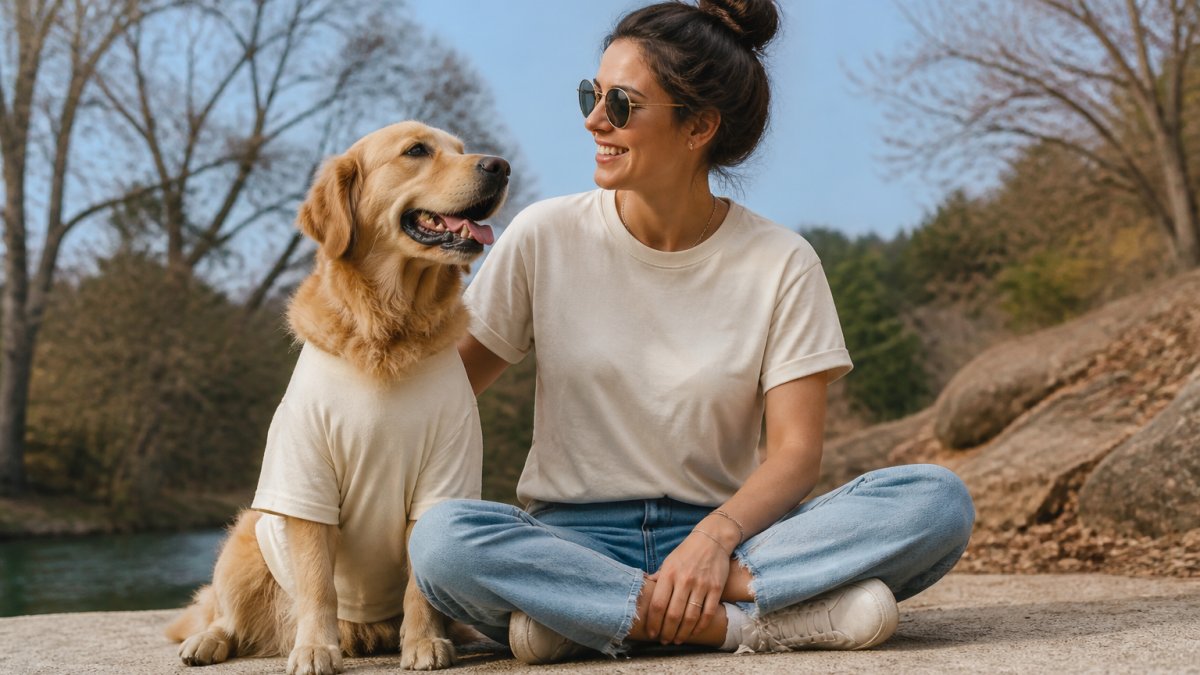
Pose-Friendly Outfits and Props Coordination
Choose outfits that allow your dog to sit, stand, lie down, and play comfortably.
Props tell a story and create visual cohesion. The key is intentional coordination.
Bandanas and neck accessories: A bandana can echo a color from your outfit.
Hats and bows: Small hats or bows work well for formal or themed shoots.
Blankets and backgrounds: Choose one that complements your outfits.
Water bowls and lifestyle props: For lifestyle shoots, color-coordinate props like water bowls or toys.
The rule: every prop should either match, complement, or intentionally contrast with your coordinated outfits.
Positioning for Comfort and Visual Balance
Position your dog where they're naturally comfortable and where the framing looks balanced.
Sitting poses: Have your dog sit slightly to the side rather than directly facing the camera.
Standing poses: Standing poses work best when your dog is looking slightly away or at a toy/treat.
Lying down poses: This is often the most comfortable position. Have your dog lie down on a blanket or grass, and position yourself at their level.
Walking poses: Action shots of you and your dog walking together can be beautiful. Keep the pace slow and steady.
In every pose, your dog's comfort comes first.
Preparing Your Dog and Managing Comfort
Schedule your photoshoot during your dog's calm time. Early morning (7-9 AM) or late afternoon (4-6 PM) often works better than midday.
Bring water and take breaks. Offer water every 10-15 minutes, and give your dog 5 minutes of rest in the shade between shooting intervals.
Keep the photoshoot short. Fifteen to thirty minutes is ideal for most dogs.
Wear clothing that makes you feel confident and comfortable. Your energy directly affects your dog.
Frequently Asked Questions
What should I wear for a photoshoot with my dog?
Wear solid colors or subtle patterns that complement your dog's coat without clashing. Neutral tones like cream, gray, or soft pastels work well in most lighting. Avoid busy designs or neon colors that distract from your dog. Comfortable, breathable fabrics like soft cotton allow you to move freely during the shoot. Consider the season and location, light layers work best for outdoor shoots. A pet themed t-shirt that matches your dog's personality or coloring creates visual harmony in photos.
How do I coordinate outfits with my pet for family photos?
Start by choosing a color palette that flatters both you and your dog. Select your dog's outfit first based on their body shape and comfort, then build your outfit around those colors. Use complementary shades rather than exact matches, this creates a coordinated look without appearing costume-like. Consider layering for depth and visual interest. Ensure harnesses or accessories are secure and won't shift during photos. Test the outfit on your dog beforehand to confirm movement range and comfort.
What colors look best in professional pet photography?
Soft, warm neutrals like cream, tan, and warm gray photograph beautifully and let your dog's features stand out. Jewel tones such as emerald or sapphire create stunning contrast in outdoor settings with natural lighting. Avoid pure white, which can cause overexposure in bright sunlight, and overly dark colors that hide your dog's shape. Test colors in your intended shooting location and lighting, indoor studio light differs from outdoor daylight. Matte fabrics photograph better than shiny ones, as they reduce glare and create softer images.
Are matching dog and owner shirts a good idea for photos?
Yes, when done thoughtfully. Matching pet themed t-shirts create a cohesive, heartfelt visual story in family photos. Choose designs that feel authentic to your lifestyle rather than overly cutesy. Ensure both outfits fit comfortably and allow full movement, your dog should never feel restricted. Coordinating colors or subtle design elements work better than identical prints. The goal is showing your bond without sacrificing your dog's comfort or safety. Quality, durable fabrics ensure both you and your dog look fresh throughout the shoot.