
What to Look for in Dog Shirts: A 2026 Fit Guide
Table of Contents
- What to Look for in Dog Shirts: The 5-Point Fit Check
- How to Measure Your Dog for Clothes in 3 Steps
- Best Fabric for Dog Shirts: Breathability and Safety
- Signs a Dog Is Uncomfortable in Clothes
- Breed-Specific Anatomical Challenges to Consider
- Behavioral Desensitization: Helping Your Dog Adjust
- Seasonal Transitions and Wardrobe Planning
- Conclusion: Your Dog's Comfort Comes First
- Frequently Asked Questions
Last Updated: September 6, 2026
Finding the perfect shirt for your pup involves more than picking a cute pattern. Knowing what to look for in dog shirts means understanding fit, fabric, and your dog's unique body language. This guide from MyRadTee, a family-owned brand that prints soft, pet-inspired tees right here in the USA, breaks down the technical side of canine apparel.
Most owners focus on aesthetics first, but the real priority is anatomy. Below, we'll show you exactly how to measure, what fabrics actually breathe, and how to spot the subtle signs that your dog is telling you "this isn't working."
What to Look for in Dog Shirts: The 5-Point Fit Check
A proper fit is the foundation of any successful dog shirt. Before you buy, run through these five points.
- Neck circumference: Measure around the base of the neck where a collar would sit. You should be able to slip two fingers between the fabric and your dog's skin.
- Chest girth: Measure the widest part of the ribcage, just behind the front legs. This is the most critical measurement for a snug fit without constriction.
- Back length: Measure from the base of the neck to the base of the tail. This prevents a shirt that rides up or bunches.
- Range of motion: After dressing your dog, watch them walk, sit, and lie down. The fabric should stretch with their movement, not fight it.
- Fur-friendly closures: Look for flat seams and closures that won't snag or mat the fur underneath.
A poorly fitted shirt can cause chafing, restrict movement, and even contribute to dog anxiety (akc.org). A garment that fits correctly should be almost forgettable to your dog.
How to Measure Your Dog for Clothes in 3 Steps
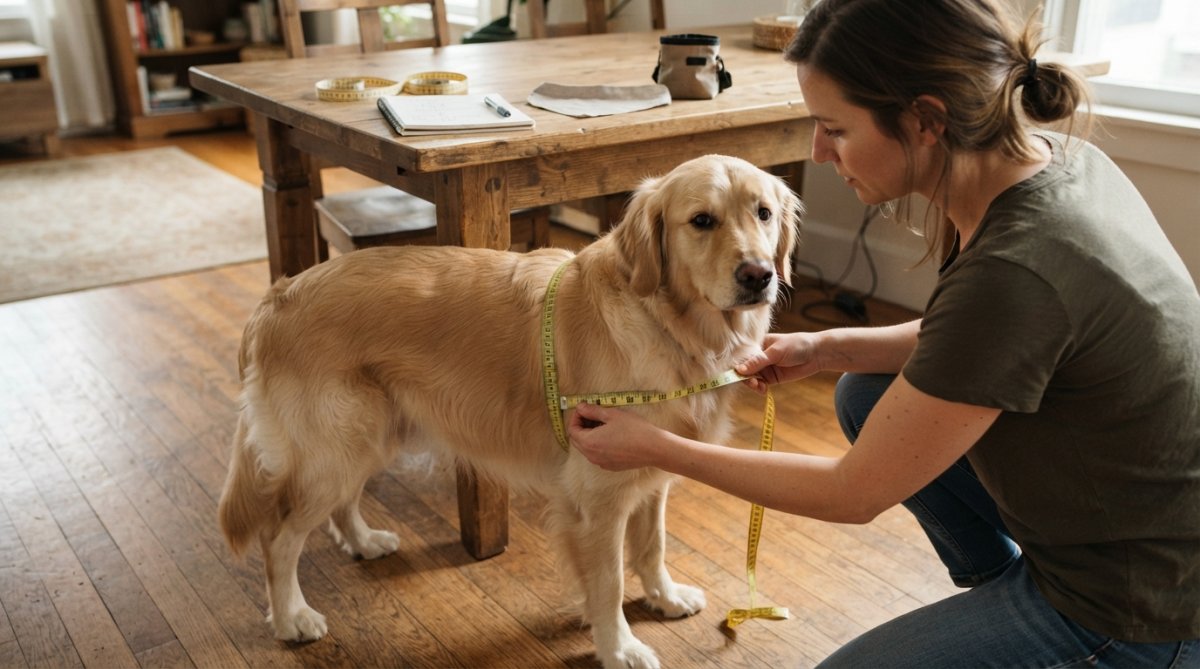
Learning how to measure your dog for clothes is the single most important skill for buying apparel online. It takes less than five minutes and prevents returns.
Step 1: Gather your tools. You'll need a soft, flexible measuring tape. If you don't have one, a piece of string and a ruler work just as well.
Step 2: Measure in the right spots. Have your dog stand in a relaxed, neutral position. Measure the neck circumference at the base of the neck, the chest girth at the widest point behind the front legs, and the back length from the base of the neck to the base of the tail. Keep the tape snug but not tight.
Step 3: Compare with the size chart. Every brand fits differently, so never assume your dog's size based on another shirt. Always check the specific brand's size chart against your dog's measurements.
Best Fabric for Dog Shirts: Breathability and Safety
The best fabric for dog shirts prioritizes breathability and moisture-wicking properties to help regulate your dog's body temperature. Dogs don't sweat like humans; they rely on panting and heat dissipation through their paws and skin. A heavy, non-breathable fabric can trap heat and lead to overheating. But not all breathable fabrics are created equal, and the chemical treatments used in some synthetics deserve as much scrutiny as the weave itself.
Fabric types: what actually works and why
- Cotton: A natural, soft choice for mild weather and indoor lounging. It's breathable and gentle, but it absorbs moisture and stays wet, which can make your dog cold and uncomfortable. For low-activity settings under 70°F, cotton is fine.
- Polyester blends (moisture-wicking): These pull sweat away from the skin and dry quickly. Look for fabrics with a knit structure (not woven) because knits stretch and recover better with movement. A common pattern is a polyester-spandex blend (roughly 90/10 to 85/15).
- Bamboo viscose: Increasingly popular in premium dog shirts. It's softer than cotton, naturally moisture-wicking, and has a silky drape that reduces chafing under the legs. The trade-off: bamboo viscose requires chemical processing to become fiber, so look for brands that certify the process is closed-loop.
- Merino wool: Rare in dog shirts but excellent for cool-weather base layers. It regulates temperature even when damp and resists odor. The downside is cost and the fact that some dogs find the texture itchy against their belly.
The toxicity angle most guides miss
Most pet parents don't realize that conventional fabric dyes and finishes can contain heavy metals, formaldehyde resins, and azo compounds. Dogs groom themselves by licking, and they spend hours with fabric pressed against their skin.
What to look for:
- OEKO-TEX Standard 100 certification: This is a globally recognized testing protocol that screens for harmful substances in textiles. If a brand lists this certification, the fabric has been tested for over 100 regulated substances.
- GOTS (Global Organic Textile Standard): If you're buying organic cotton, GOTS certification ensures both the fiber and the processing meet environmental and social criteria. It's the gold standard for organic claims.
- Low-impact or fiber-reactive dyes: These bind to the fabric at a molecular level and require less water and fewer chemicals than conventional dyes. They're not a certification, but brands that mention them are usually more thoughtful about their supply chain.
UPF ratings: what the number actually means
A UPF (Ultraviolet Protection Factor) rating on a dog shirt is not a marketing gimmick, but it's also not a substitute for shade. UPF 50+ blocks roughly 98% of UV radiation (the CDC). For context, a standard white cotton t-shirt provides about UPF 5 to 8 once wet (peer-reviewed research). If your dog has a thin coat, light-colored skin, or a history of sunburn on the belly or ears, a UPF-rated shirt is a legitimate purchase. But remember: UPF is measured on new, dry fabric, and stretching the fabric reduces UPF effectiveness by up to 50%.
The heat-trapping mechanism you should understand
Dogs cool themselves primarily through panting and vasodilation in the paws and ears. When you put a shirt on a dog, you are insulating those heat-dissipation zones on the torso. A breathable fabric allows ambient air to circulate and moisture to evaporate, creating a cooling effect; a non-breathable fabric creates a microclimate of trapped humidity against the skin. This is why a dog can overheat in a thin costume faster than in a thicker, breathable shirt. The weave matters more than the weight. Look for mesh panels under the chest or along the flanks on shirts designed for active dogs.
Signs a Dog Is Uncomfortable in Clothes
Recognizing the signs a dog is uncomfortable in clothes is crucial for their safety and well-being. While some initial hesitation is normal, persistent distress signals mean the shirt isn't working. There are two distinct failure modes, and they require different responses.
Failure Mode 1: Acute stress (the shirt is wrong for this dog)
This is a fear or panic response. It usually appears within the first 5 to 10 minutes of wear and escalates quickly. The dog's nervous system is interpreting the shirt as a restraint or a threat. Signs include:
- Excessive panting: More than just a few quick breaths; this is rapid, continuous panting with the tongue fully extended. This is not a cooling mechanism at this point; it's a stress response driven by adrenaline.
- Freezing or refusal to move: A dog that stands stiffly, tail tucked, and will not take a step forward is not being dramatic. They are exhibiting a classic tonic immobility response. This is a sign of significant distress.
- Attempts to remove the shirt: Persistent scratching, biting, or rolling aggressively. A few attempts in the first minute are normal curiosity. Continuous attempts after 5 minutes are a red flag.
- Whining or yelping: Vocalization that is not playful is a direct communication of distress.
Failure Mode 2: Physical discomfort (the fit or fabric is wrong)
This is a subtler, slower-building problem. The dog may seem fine for the first 15 minutes, then gradually show signs of irritation. This is often a fit issue, not a psychological one. Signs include:
- Chafing or rubbing: The dog repeatedly licks or nibbles at a specific spot, usually under the front legs or around the neck. This indicates the seam or hem is rubbing raw.
- Restricted gait: Watch your dog trot. If the front legs are moving in a shortened, choppy stride, the chest girth is too tight. If the back legs are kicking at the shirt's hem, the back length is too long.
- Excessive scratching without skin irritation: This often points to a fabric sensitivity or a label rubbing against the skin. Remove the shirt and check for any tags or rough seams.
The adjustment curve: what normal looks like
Normal adjustment follows a predictable curve. In the first 2 to 3 minutes, a dog may walk oddly, shake, or try to rub against furniture. This is sensory processing, not distress. By minute 5, most dogs settle. By minute 10, they should be engaging in normal behaviors. If your dog is still showing avoidance behaviors at the 10-minute mark, the shirt is not working.
The 3-strike rule: a practical protocol
Most veterinary behaviorists recommend a structured approach to testing a new shirt. Try this protocol before you commit to keeping a garment:
- First attempt: Put the shirt on for 5 minutes indoors. Engage your dog in a high-value activity (treats, a favorite toy). If they are distressed at minute 5, remove the shirt and wait 24 hours.
- Second attempt (next day): If the first attempt was manageable, extend to 15 minutes. Take a short walk. Watch for the physical discomfort signs above.
- Third attempt (day 3): If the dog is comfortable for 30 minutes of mixed activity, the shirt is a keeper. If they regress at any stage, the shirt itself is the problem, not your dog's attitude.
When to abandon the shirt entirely
Some dogs will never tolerate clothing. Breeds with high prey drive or strong body-awareness sensitivities (often sight hounds, some terriers) may find any garment inherently stressful. If you've followed the desensitization protocol and your dog still shows acute stress signs after 3 to 4 sessions, respect that boundary. A dog shirt is optional gear, not a necessity; forcing it will damage your training relationship.
Breed-Specific Anatomical Challenges to Consider
A one-size-fits-all approach fails when you consider the wide variety of dog anatomies. Breed-specific anatomical challenges mean you must look beyond the basic size chart.
Dogs with deep chests, like Greyhounds or Boxers, often need a longer back length and more room in the chest girth, even if their weight suggests a smaller size. Conversely, breeds with barrel chests, such as French Bulldogs or Pugs, may need a larger size to accommodate their wide ribcage, but the shirt might be too long in the back. For these dogs, look for "bully" or "barrel-chested" fits.
Short-legged breeds like Dachshunds or Corgis have a long back and short legs, so a standard shirt might bunch up around the middle. Look for styles designed for these proportions.
Behavioral Desensitization: Helping Your Dog Adjust
Behavioral desensitization is a training technique that helps your dog associate wearing clothes with positive experiences. It's a patient, step-by-step process that prevents dog anxiety.
- Start slow: Introduce the shirt as a flat object. Let your dog sniff it and reward them with a treat for investigating.
- Use positive reinforcement: For short periods, drape the shirt over their back without fastening it, offering treats and praise throughout.
- Practice brief sessions: Once they're comfortable, put the shirt on for just a few minutes and engage them in a fun activity, like a game of fetch or a walk. This distracts them and builds a positive connection.
- Gradually increase duration: Slowly extend the time your dog wears the shirt, always rewarding calm behavior.
The goal is to make wearing a shirt a predictor of fun, not a source of stress. A relaxed, happy dog makes seasonal wardrobe changes much easier for everyone.
Seasonal Transitions and Wardrobe Planning
Building a seasonal wardrobe for your dog is about more than just fashion; it's about comfort and safety in changing weather.
For chilly fall days or cool spring mornings, a lightweight cotton or fleece shirt provides warmth without overheating. In the summer, prioritize breathable, moisture-wicking fabrics for sun protection during early morning or evening walks. During deep winter, a shirt alone usually isn't enough; you'll need a proper insulated coat for extended time outdoors.
A versatile collection of dog shirts in different weights is more practical than a single heavy coat, allowing you to adapt to daily temperature swings.
Conclusion: Your Dog's Comfort Comes First
Ultimately, the secret to a great dog shirt lies in the details we've covered: accurate measurements, breathable fabrics, and a keen eye for your dog's behavioral cues. By following this fit guide, you're investing in your dog's comfort and happiness.
At MyRadTee, we understand this bond because we live it. We design our soft, high-quality, pet-inspired tees for the humans who love their dogs, using comfortable materials perfect for lounging or your next outdoor adventure. We provide detailed size charts on every product page, and our customer service team is ready to help you find the right fit.
Get started with MyRadTee and find apparel that celebrates your unique bond, made for comfort from the first wear.
Frequently Asked Questions
How do I know if a dog shirt fits correctly?
A correct fit allows two fingers to slide between the fabric and your dog's body at the chest and neck. The shirt should not restrict range of motion in the legs or shoulders. Watch your dog walk, sit, and lie down. The fabric should stay smooth without bunching or pulling. If the shirt rotates, rides up, or leaves red marks on the skin, size up. Re-measure every few months, especially for growing puppies.
Are there specific fabrics that are safer for dogs to wear?
Choose breathable, stretchable materials like cotton blends or moisture-wicking performance fabrics. These allow body temperature regulation and prevent overheating. Avoid stiff synthetics that chafe and fabrics with harsh dyes that can irritate sensitive skin. Look for fur-friendly closures and flat seams that don't rub. For sun protection, check the UPF rating on the label. Machine-washable fabrics are also safer because they stay cleaner with fewer skin irritants.
Should dogs wear shirts all day?
No, dogs should not wear shirts all day, especially during the first few uses. Start with 15 to 30 minute sessions and observe your dog's behavior. Shirts serve a purpose for warmth, sun protection, or anxiety relief, but they are not meant for constant wear. Take the shirt off during meals, crate time, and overnight. Always remove the shirt if you notice panting, restlessness, or attempts to scratch or bite at the fabric.
What are the signs that a dog is uncomfortable in clothing?
Common signs include freezing in place, panting excessively, drooling, and trying to back out of the shirt. Some dogs show restlessness by pacing or shaking their body repeatedly. Others scratch or bite at the fabric. A tucked tail, flattened ears, or whale eye (showing the whites of the eyes) indicate stress. Watch for reduced range of motion when walking. If these signs continue beyond a few minutes of distraction, remove the shirt and revisit desensitization training.
How often should I remeasure my dog for shirt sizing?
Remeasure your dog every three to four months. Weight changes, seasonal coat growth, and muscle development all affect garment sizing. Puppies need monthly measurements because they grow quickly. Senior dogs may change size due to weight shifts or muscle loss. Always measure before ordering a new shirt, even if you have bought the same brand before. Use a soft tape measure and follow the brand's size chart, since sizing varies between manufacturers.